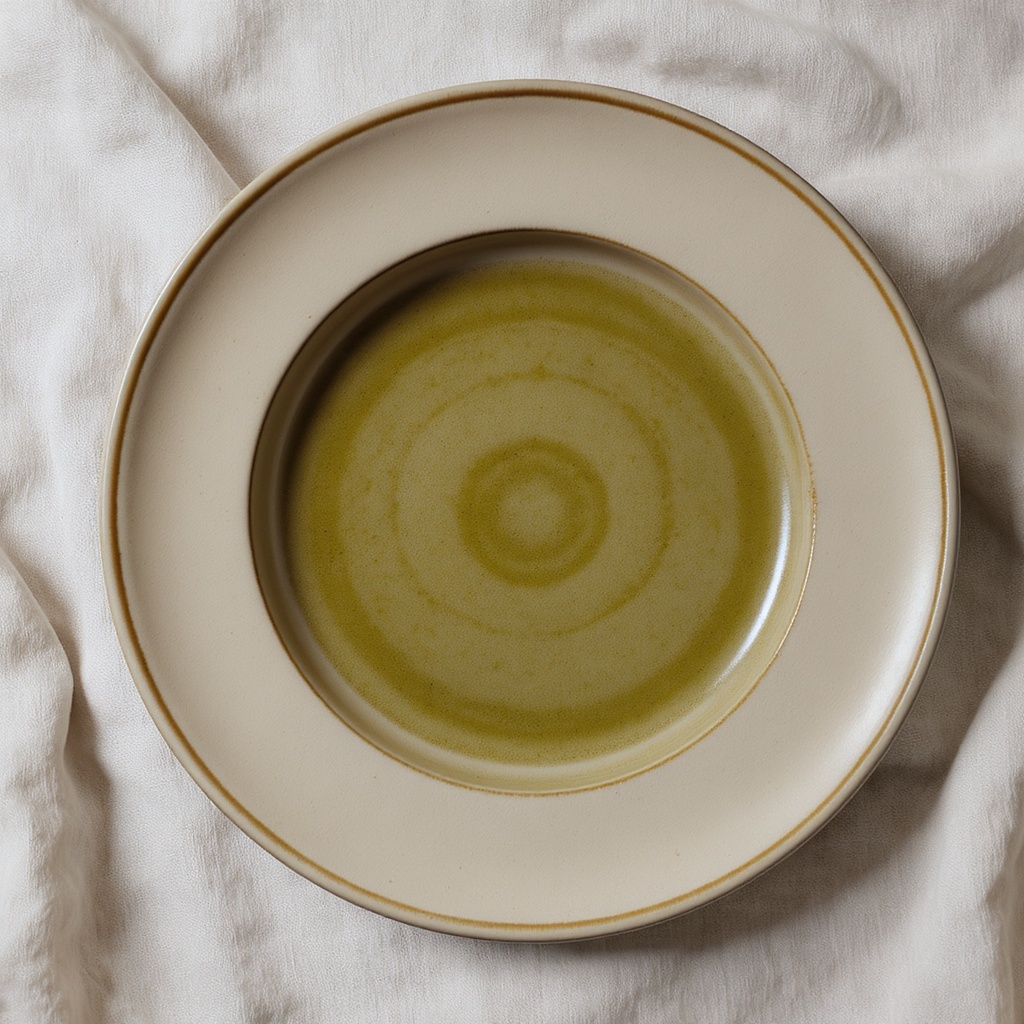
Prototype 001
Anchor Plate
One product. One definitive statement.
The Anchor Plate is not a decorative object. It is the fixed point around which a place setting organizes itself. Every proportional decision — diameter, rim height, well depth, foot angle — is made in service of this single role.
This is Meld's first product. Everything else follows from it.
| Diameter | 280 mm | Dinner plate. Not shared, not decorative. |
| Well depth | 14 mm | Shallow. Food rests in the plane, not in a bowl. |
| Rim height | 8 mm | Barely there. Slight containment, no wall. |
| Rim angle | 22° from horizontal | Controlled drainage toward center. No pooling. |
| Well offset | +6 mm toward diner | Compensation for the visual weight of a placed fork and knife. |
| Foot | 36 mm ring, 2.5 mm tall | Narrow ring foot. The plate reads as floating. |
| Weight | 480 g | Heavy enough to feel permanent. Light enough to hold. |
| Surface finish | Matte, fully vitrified | No reflection. The plate absorbs light. |
280 mm is not arbitrary. It is the diameter at which a dinner plate ceases to look like a snack dish and begins to impose its own gravity on the table. At 28 cm, the plate dominates the place setting without crowding — it is the fixed object around which everything else arranges itself.
The 22° rim is a drainage decision, not a stylistic one. A steeper rim (30°+) collects sauce at the edge, where it cools and separates. A flatter rim (15° or less) allows liquid to run freely, making the plate feel unstable. The 22° angle keeps sauces in slow, controlled migration toward the center — where food temperature is most consistent.
The interior surface is a reduction-fired iron oxide wash over the stoneware body. The effect is a depth of tone — not color — that changes with light source and viewing angle. Matte vitrification means the surface reads as material, not coating. The plate is one thing, made from the same clay, fired once.
Offsetting the well 6 mm toward the diner is a correction for the optical illusion created by the completed place setting. A centered well appears to lean backward when flanked by fork and knife. The 6 mm compensation shifts the visual center forward, where the food lives, aligning the plate's mass with the diner's eye line.
Fine stoneware. Iron-rich Belgian clay body, typically 3–5% iron oxide content. Speckled texture from fine grog (0.5–1 mm mesh). Muted warm gray in raw state, warming significantly toward bone and sand through firing. The clay body color is part of the design — not an accident of production.
1260°C — 1280°C. High-fired stoneware. Fully vitrified at temperature, no porosity in the body. One bisque firing (900°C) followed by one glaze firing (1260–1280°C). Total cycle: approximately 14 hours heat to peak, 45 minutes soak, natural cooling over 18–24 hours.
Iron oxide wash on well interior — single-layer application, thin, consistent. No added colorants. The glaze depth comes from the clay body tone visible through the thin iron layer. Outer perimeter left unglazed, exposing the fired stoneware body — the contrast between glazed interior and raw exterior is intentional.
Lead-free, cadmium-free. All materials FDA food-safe compliant. Stoneware vitrified to zero water absorption. Dishwasher safe, though hand-washing preserves the surface. Microwave safe (no metal content). Freezer safe.
Stoneware production sourced from a single Belgian workshop within 150 km of Antwerp.
Ignace and Charlotte built ARTISANN from a restaurant background — Ignace as chef, Charlotte as ceramicist. Their expertise is in stoneware and porcelain with special glazes, with specific experience designing for restaurant and hospitality use. They have worked directly with Belgian restaurants to produce custom plate forms. Their production is handmade, small batch, and precise.
Why this workshop: The chef-ceramicist pairing means they understand both the architectural and functional demands of a plate. Their restaurant portfolio demonstrates familiarity with the hospitality environment — thermal shock resistance, stacking stability, durability under commercial use. Contact: artisann.be
Twenty years of stoneware and porcelain work. Mie's practice is sculptural and architectural — organic forms with strong material presence. She works from the Belgian coast, drawing from sea tones in her palette. Experienced in custom production runs.
Why this workshop: Architectural sensibility and stoneware depth. Her work has the material seriousness this project requires. Contact via VAWAA or direct inquiry.
Bucky (Peggy Geens). Stoneware sculpture and vessels in small numbered series. Bel-Art is the trade and gallery channel — they have production infrastructure for small runs and custom commissions. Exhibited at MAD Brussels and Flanders DC.
Why this workshop: Trade-ready production with gallery-quality standards. Their stoneware firing protocols (1200–1300°C) match the spec exactly. Best for architectural plate forms with higher production volume requirements. Contact: bel-art.be
Recommended workshop: Contact ARTISANN first. Their restaurant background and ceramic expertise, combined with proximity to Antwerp, makes them the right fit for a first production run of the Anchor Plate. Request a sample prototype in the Belgian iron-rich stoneware body before committing to a full run.