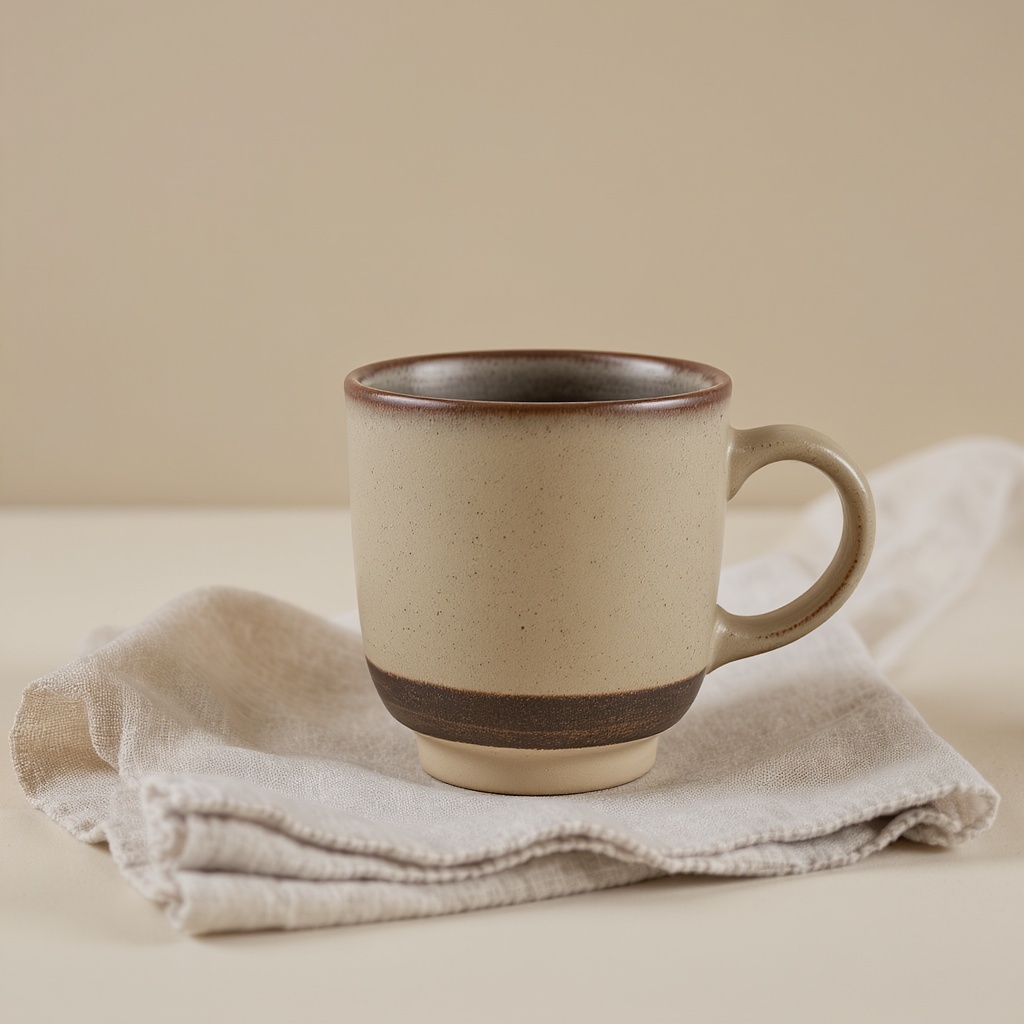
Prototype 005
Holding Cup
Espresso. Cordials. The smaller pauses.
The handleless cup asks more of you. You wrap your hands around it — warmth transfers directly, the ceramic becomes an extension of your grip. It is more intimate than a handled cup. More deliberate. You do not drink from it by accident.
180 ml. Not enough for a long coffee. Exactly enough for what matters.
| Capacity | 180 ml | Espresso standard. Not a lungo cup, not a demitasse — espresso proper. The capacity defines the form. |
| Wall height | ~65 mm | Tall relative to the capacity. The cup holds its volume vertically — the form is slender, not squat. |
| Rim diameter | ~72 mm | Wide enough for a proper sip. Narrow enough that the cup feels held, not cupped. |
| Base diameter | ~45 mm | Narrow base. The cup is stable but not flat-footed — it reads as a vessel, not a saucer. |
| Wall thickness | ~3.5 mm | Thin enough to transfer heat to the hands. Thick enough to hold hot liquid without burns within a reasonable time. The ceramic is the interface. |
| Rim | Slightly thinner than wall, 1.5 mm rolled | The lip is the most refined surface — it meets the mouth. The roll is subtle, not pronounced. |
| Foot | 18 mm ring, 2 mm tall | Small ring foot. The cup lifts slightly off the surface — minimal, functional. |
| Weight | ~150 g | Light enough for the cup to feel like part of the hand. Heavy enough to have substance. |
| Surface finish | Matte, fully vitrified | Full iron oxide wash — interior and exterior. No handle means the entire surface is the tactile surface. |
Removing the handle is not minimalism — it is a repositioning. The handle removes the act of holding from the object. The handleless cup puts it back: you must hold the cup to drink from it. This changes the temperature experience, the grip, the relationship between the drink and the person drinking it. The cup is held. That is the point.
The capacity is the first decision and it drives everything. At 180 ml, the cup is too small for a long drink and large enough for a complete espresso. It is precisely the volume of an espresso pulled correctly — no more, no less. The form serves one drink, completely. This constraint is a design statement.
At 3.5 mm wall thickness, the cup transfers heat to the hands slowly enough that the drinker is not burned, and quickly enough that the warmth is felt. This is a narrow margin — the cup must be thick enough for thermal comfort and thin enough to feel responsive. The correct wall thickness for 180 ml of espresso at drinking temperature is a functional specification, not an aesthetic one.
The cup is taller than it is wide at the base. This proportions it for the grip: the hand wraps the narrow base and the cup opens upward. It feels like holding something present, not something flat. The cup has a sense of volume that a squat demitasse does not — it holds its content visibly, the liquid level always visible through the wide rim.
Fine stoneware. Iron-rich Belgian clay body, 3–5% iron oxide content. The thin wall (3.5 mm) demands a clay body with high green strength — the cup must hold its form through drying and into the bisque firing without warping. Fine grog content is kept low (0.3–0.7 mm mesh) to maintain the surface quality required for the tactile exterior.
1260°C — 1280°C. High-fired stoneware. The thin wall makes the cup vulnerable to thermal shock during the firing cycle — the workshop must use a slow ramp to 600°C during the bisque to prevent cracking, and ensure even heat distribution in the glaze firing. The foot ring, being the thickest part of the form, is the most vulnerable to deformation.
Full iron oxide wash — interior and exterior. The handleless form means every surface is tactile: the cup is held in both hands, the exterior receives the same treatment as the interior. No contrast between glazed and unglazed zones. The surface is continuous, uniform, matte — the ceramic is one material from rim to foot ring.
Lead-free, cadmium-free. FDA food-safe compliant. Fully vitrified, zero porosity. Dishwasher safe — though the small size means hand-washing is practical and preserves the surface. Microwave safe. The thin wall makes the cup sensitive to sudden thermal shock — do not use for oven applications.
Stoneware production sourced from Belgian workshops with small-scale vessel and cup production experience within 150 km of Antwerp.
Ignace and Charlotte built ARTISANN from a restaurant background — Ignace as chef, Charlotte as ceramicist. Their production of small-scale tableware vessels makes them the primary contact for the Holding Cup. The thin wall and precise dimensional requirements (180 ml capacity, 3.5 mm wall) require a workshop with experience in jiggering or throwing small vessels with consistent wall thickness.
Why this workshop: Restaurant-grade production experience with small vessel forms. They understand the hospitality use case — thermal comfort, grip, the relationship between the cup and the hand during service. Contact: artisann.be
Twenty years of sculptural and architectural ceramic work. Mie's sculptural approach to vessel forms — her precision with thin-walled ceramic construction — is directly applicable to the Holding Cup's technical demands. Her coastal practice has a particular interest in small domestic objects with strong material presence.
Why this workshop: Sculptural thin-wall experience and material precision. Strong candidate if the Holding Cup requires bespoke mould development or custom glaze testing. Contact via VAWAA or direct inquiry.
Bucky (Peggy Geens). Stoneware sculpture and vessels in small numbered series. Bel-Art has production infrastructure for small-scale cup forms with gallery-quality finishing. Their stoneware firing protocols (1200–1300°C) match the spec exactly, and their trade channel means they are experienced in consistent small-batch production.
Why this workshop: Trade-ready production with small-scale vessel capability and consistent finishing standards. Best for larger production runs of the Holding Cup if it moves beyond prototype. Contact: bel-art.be
Recommended workshop: Contact ARTISANN first. The Holding Cup's thin wall demands workshop precision — wall consistency is the primary risk in production. Request a prototype focused on: wall thickness uniformity measured across three points on the cup body, the foot ring flatness and height, and thermal comfort testing with 90°C liquid held for 3 minutes.