Prototype 003
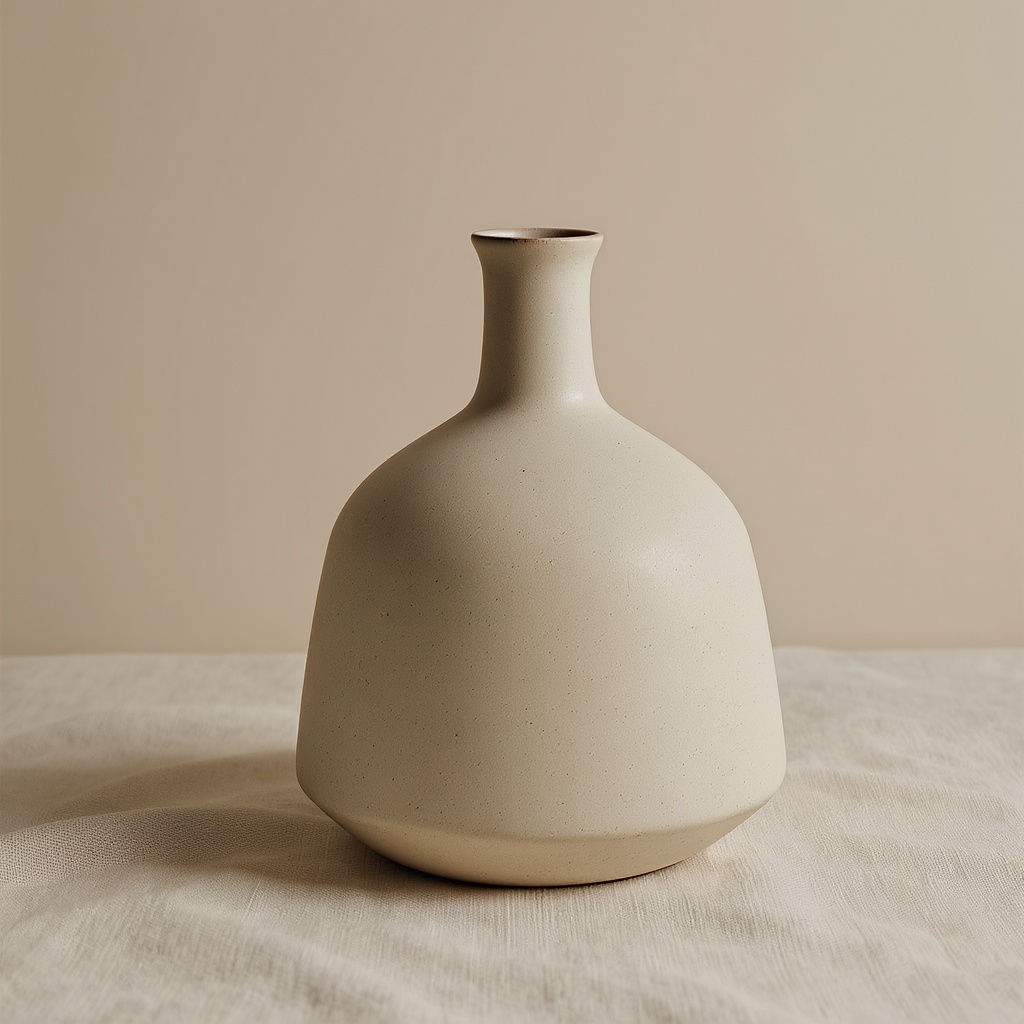
Low Vessel
Water. Wine. The table's quietest act.
The Low Vessel holds water or wine at the table without performing. Its low profile keeps it from interrupting — it stays below the visual plane of the place setting, available without demanding attention. The form is honest about what it is: a vessel. Nothing more.
350 ml. Enough for a long dinner. Not enough to become the center of one.
| Capacity | 350 ml | Sufficient for a full dinner service. Not generous enough to become storage. |
| Body height | ~95 mm | Low profile — the vessel sits well below the bowl's rim when placed on the table. |
| Body diameter | ~120 mm | Wide and stable. The vessel cannot tip easily — low center of gravity. |
| Neck height | ~28 mm | Short. The neck is not decorative — it controls pour and provides grip. |
| Neck diameter | ~28 mm | The opening is narrow enough to control flow but wide enough for ice. |
| Pour lip | Slight outward flare, 2–3° | Controlled pour. No dripping. The lip is a functional decision, not an aesthetic one. |
| Base | 35 mm ground foot, flat | Ground and polished. Flat base — the vessel sits level on any surface. |
| Weight (empty) | ~280 g | Light enough to pour with one hand. Heavy enough to feel deliberate. |
| Surface finish | Matte, fully vitrified | Iron oxide wash interior and exterior. Consistent tone, no applied decoration. |
A tall carafe dominates the table — it sits above everything, becomes the visual anchor. The Low Vessel is designed to sit below that threshold. It remains in peripheral vision. The diner reaches for it naturally because it is never in the way. Low is not a compromise; it is the correct answer for a serving vessel that does not want to be the point.
350 ml is deliberate. A larger vessel would store wine for the whole dinner — removing the act of choosing, decanting, serving. At 350 ml, refilling is required. The refill is a moment: the sommelier gesture, however humble, that belongs at any table worth sitting at. The capacity is the feature.
The 28 mm neck, the slight outward lip, the broad base: these are a system. The narrow neck controls stream. The broad base provides stability in the hand and on the table. The lip prevents the drip that ruins a tablecloth. Everything here is in service of a single act — pouring — done well.
The Low Vessel shares the iron oxide wash treatment of the Anchor Plate and Threshold Bowl. It is part of the same language: Belgian stoneware, matte vitrification, the same clay body tone visible through the thin iron layer. Placed on the table with the other pieces, it speaks the same material dialect without identical form.
Fine stoneware. Iron-rich Belgian clay body, 3–5% iron oxide content. The Low Vessel's balanced proportions — low, wide, stable — rely on consistent clay body density and even wall thickness throughout. Fine grog (0.5–1 mm mesh) provides structural integrity through firing without introducing visible texture at this scale.
1260°C — 1280°C. High-fired stoneware, fully vitrified. The carafe form is technically demanding: the transition between the broad body and the narrower neck must hold through the glaze firing without warping. Workshop should use internal support (kiln stilts or custom setters) during the high-temperature cycle to maintain the form's symmetry.
Full iron oxide wash — interior and exterior, same consistent treatment. No added colorants. The glaze covers the complete vessel surface including the neck and pour lip, ensuring the material tone is uniform and complete. No contrast between glazed and unglazed surfaces as seen in the plate and bowl forms — the carafe is fully enclosed, so the exterior receives the same treatment.
Lead-free, cadmium-free. FDA food-safe compliant. Fully vitrified, zero porosity. Dishwasher safe — the broad form is stable in a rack. Hand-washing recommended to preserve the matte surface. Microwave safe. Not oven safe (thermal shock risk with narrow neck geometry).
Stoneware production sourced from Belgian ceramic workshops with vessel and carafe production experience within 150 km of Antwerp.
Ignace and Charlotte built ARTISANN from a restaurant background — Ignace as chef, Charlotte as ceramicist. Their production of functional stoneware vessels makes them the primary contact for the Low Vessel. Their experience with hospitality-grade ceramic forms — including carafe-style serving pieces — is directly applicable here. Charlotte's ceramic training and production precision are essential for the neck-to-body transition in this form.
Why this workshop: Restaurant familiarity means they understand how a carafe behaves in service — the pour mechanics, the table placement, the thermal demands of holding wine or water. Contact: artisann.be
Twenty years of sculptural vessel work. Mie's architectural approach to form — the balance between silhouette and function — is exactly right for the Low Vessel's design logic. Her work with organic vessel forms translates to the carafe geometry required here. She has produced vessel forms with comparable height-to-width ratios.
Why this workshop: Sculptural vessel experience and architectural sensibility. Strong candidate for a production run if the form requires bespoke development beyond the initial prototype. Contact via VAWAA or direct inquiry.
Bucky (Peggy Geens). Stoneware sculpture and vessels in small numbered series. Bel-Art has the production infrastructure for ceramic carafe forms and the gallery-quality finishing standards this piece requires. Their experience with vessel geometry and the technical demands of closed-form ceramic production makes them a viable production partner.
Why this workshop: Trade-ready production with gallery-quality finishing. Best for larger production runs if the form moves beyond prototype. Contact: bel-art.be
Recommended workshop: Contact ARTISANN first. Their restaurant context, ceramic precision, and proximity to Antwerp make them the right first contact for the Low Vessel. Request a prototype focusing on: the pour lip accuracy, the base flatness, and the balance of the vessel when filled to 350 ml.