Prototype 002
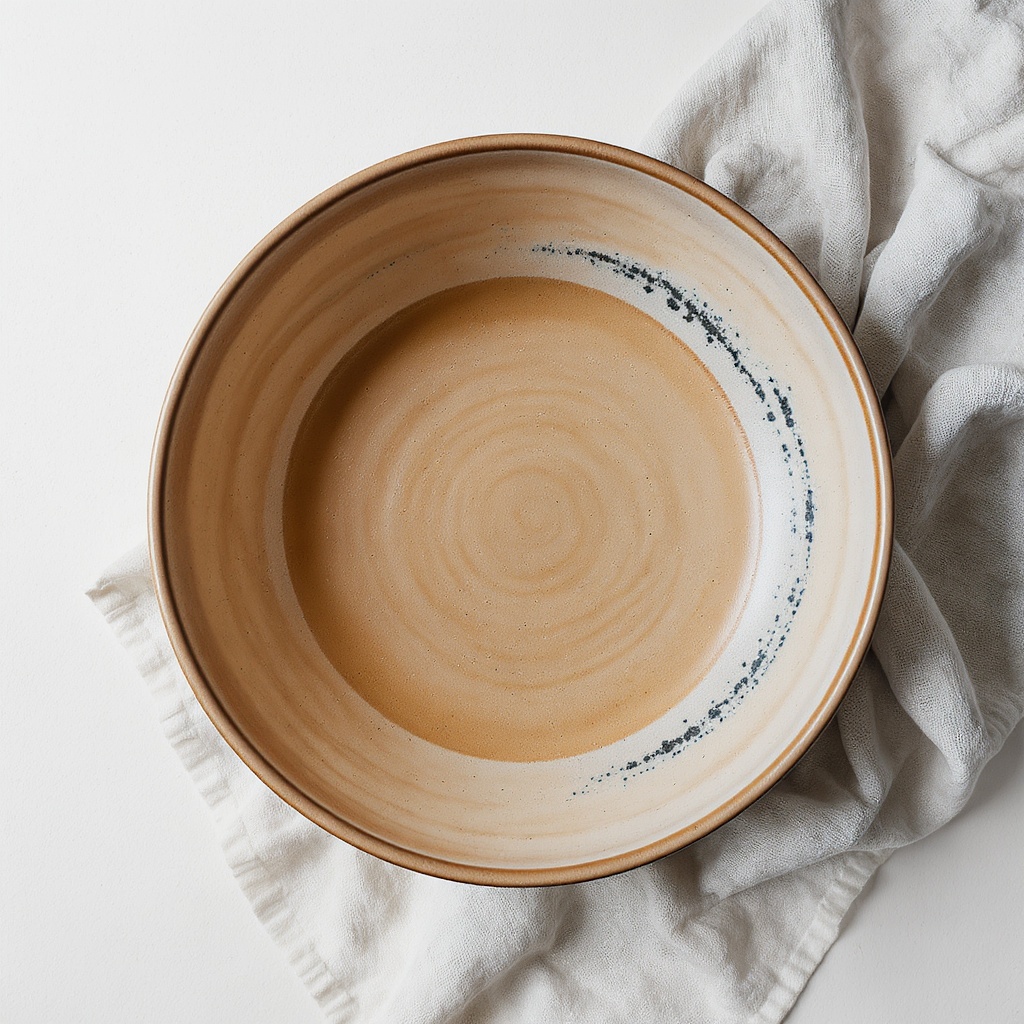
Threshold Bowl
The bowl that holds the pause.
The Threshold Bowl is built for slow eating — soup, grain bowls, anything that invites the spoon back. Its wide, shallow form resists the verticality that makes a bowl feel clinical. Food spreads. Breathes. Gives you time.
The form rewards patience. It asks you to stay.
| Diameter | 240 mm | Wide opening. Wide invitation. Not a soup mug. |
| Well depth | 52 mm | Shallow relative to diameter. Food stays low in the bowl — visible, present. |
| Wall angle | 18° from vertical | Almost straight. The bowl widens gradually, not abruptly. |
| Rim | 1.5 mm thick, slightly softened | Rounded but not rolled. Finger-friendly without being delicate. |
| Base diameter | ~110 mm | Stable on the table. No tipping. Sits flat. |
| Foot | 28 mm ring, 3 mm tall | Minimal ring foot. Bowl reads as resting, not elevated. |
| Weight | 520 g | Heavier than it looks. Stability is part of the experience. |
| Surface finish | Matte, fully vitrified | Interior iron oxide wash. Unglazed exterior at base. |
A 240 mm opening is not large for the sake of it. It is wide because wide surfaces slow eating. The spoon travels further. The portion feels more generous than it is. The bowl invites lingering — you cannot eat it quickly without feeling like you are interrupting something.
At 52 mm, the well is deep enough to contain liquid without a wall, and shallow enough that food is never hidden from view. The content is always present, always retrievable, never buried. The bowl keeps you in contact with what you are eating.
A steeper wall would make the bowl feel closed — a container you dip into. A flatter wall makes it feel like a surface, a plate. The 18° angle keeps it in between: vessel and surface simultaneously. Food gathers at the center but is never obscured.
At 520 g, the Threshold Bowl has presence. You feel it before you eat from it. That weight — grounded, unmoveable — is not incidental. It anchors the meal. A light bowl feels temporary; this one feels like it was always there.
Fine stoneware. Iron-rich Belgian clay body, 3–5% iron oxide content. Fine grog (0.5–1 mm mesh) for structural stability in the wide, shallow form. The clay body tone is part of the design — bone and sand through firing, not a surface applied over the material.
1260°C — 1280°C. High-fired stoneware. Fully vitrified — zero water absorption. Bisque at 900°C, glaze firing at cone 10. The wide form requires even heat distribution during firing; workshop must use setter tiles or kiln wash to prevent warping in the large flat silhouette.
Interior: thin iron oxide wash — same reduction-fired treatment as the Anchor Plate. Exterior: unglazed stoneware body except for the foot ring, which receives a thin matte glaze to protect the base surface. The contrast between glazed interior and raw exterior is intentional, as it is on the Anchor Plate.
Lead-free, cadmium-free. FDA food-safe compliant. Fully vitrified with zero porosity. Dishwasher safe — though hand-washing preserves the raw exterior surface. Microwave safe. Freezer safe.
Stoneware production sourced from Belgian workshops with experience in wide-form vessels and bowl production within 150 km of Antwerp.
Ignace and Charlotte built ARTISANN from a restaurant background — Ignace as chef, Charlotte as ceramicist. Their experience with wide-form tableware and hospitality production makes them the natural first contact for the Threshold Bowl. Their knowledge of firing dynamics for broad, shallow forms is directly applicable here.
Why this workshop: Restaurant background and ceramic precision. They understand how wide bowls behave in service — thermal shock, stacking, the physical demands of hospitality use. Contact: artisann.be
Twenty years of stoneware and porcelain work. Mie's architectural sensibility is an asset for the wide, low profile of the Threshold Bowl. Her experience with organic vessel forms and large-scale ceramic production means she can handle the dimensional demands of a 240 mm opening.
Why this workshop: Architectural vessel experience and sculptural approach to form. Strong candidate for production runs with higher complexity requirements. Contact via VAWAA or direct inquiry.
Bucky (Peggy Geens). Stoneware sculpture and vessels in small numbered series. Bel-Art has production infrastructure suited to architectural bowl forms and the kiln capacity to fire wide pieces evenly. Their trade and gallery channel means they are accustomed to quality standards that match the Anchor Plate spec.
Why this workshop: Trade-ready production infrastructure with gallery-quality standards. Best for larger production runs with consistent quality requirements. Contact: bel-art.be
Recommended workshop: Contact ARTISANN first. Their understanding of hospitality use, combined with their ceramic precision, makes them the right fit for the Threshold Bowl's first production run. Request a prototype in the Belgian iron-rich stoneware body — the wide form will need firing tests to confirm the base holds flat through the glaze cycle.
Prototype 002 — awaiting first production run
The bowl that earns its place at the table.
← Collection