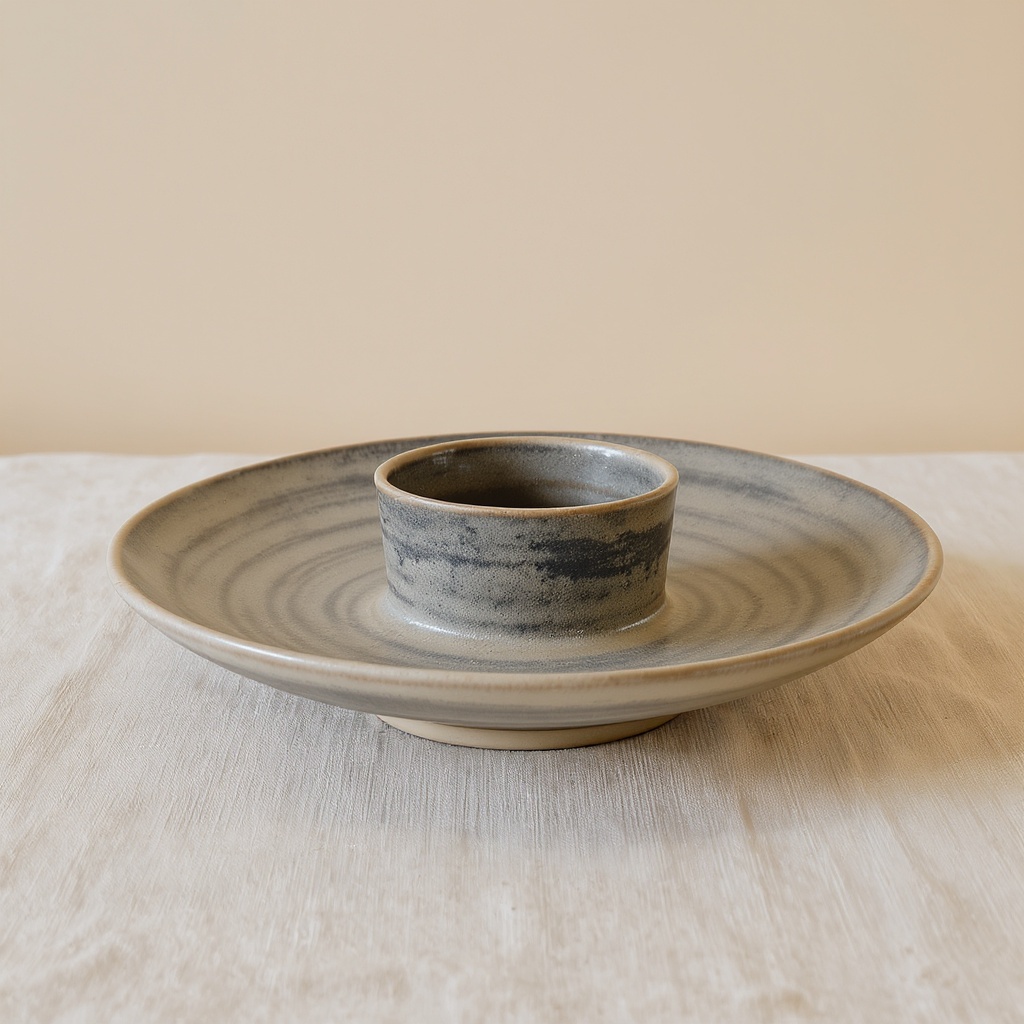
Prototype 004
Still Point Plate
The plate that asks the food to stand.
The Still Point Plate is built for vertical plating — dishes where height is part of the argument. The 35 mm well gives food somewhere to stand instead of sprawl. The plate does not contain food. It elevates it.
260 mm is the same family as the Anchor Plate. Slightly smaller, significantly deeper. They belong together at a table.
| Diameter | 260 mm | Same family as the Anchor Plate (280 mm). This is the deep cousin — smaller in diameter, taller in well. |
| Well depth | 35 mm | The defining dimension. Food stands here. 35 mm is enough for stacking, layering, building. Not so much that the plate feels like a bowl. |
| Rim height | 10 mm | Slightly taller than the Anchor Plate's 8 mm. The rim contains the well's volume; it is part of the vertical architecture. |
| Rim angle | 25° from horizontal | Steeper than the Anchor Plate (22°). A deeper well needs a steeper wall to maintain visual proportion at the rim. |
| Well floor | Flat, with 4° inward slope | Food does not slide to the center — it sits. The floor is nearly flat, with just enough slope to assist with sauce collection at service. |
| Foot | 32 mm ring, 3 mm tall | Narrow ring foot. The deeper well raises the visual mass of the plate; the foot keeps it grounded and light-reading. |
| Weight | 510 g | Comparable to the Anchor Plate. The deeper well does not make it heavier — the material is distributed differently, not added. |
| Surface finish | Matte, fully vitrified | Interior iron oxide wash. Unglazed outer perimeter. Same material language as the Anchor Plate. |
The well depth is not a stylistic choice — it is the functional requirement that drives the rest of the form. At 35 mm, the well can hold stacked elements: a base, a layer, a garnish. The food builds. The plate becomes a stage. This is why the rim height rises to 10 mm and the rim angle steepens to 25° — these are compensations for the depth, not independent decisions.
260 mm is slightly smaller than the Anchor Plate's 280 mm — a deliberate relationship, not an accident. When both are on the table, the smaller, deeper plate reads as the secondary object: the special occasion piece, the course that matters most. The diameter is part of the hierarchy. Both plates are family; one is the anchor, one is the point.
Shallow plates distribute food across a plane — the eye moves laterally. Deep plates direct the eye upward — food gains presence, height, drama. The Still Point Plate is designed for the chef who wants to build something that sits above the surface rather than across it. The plate supports that intention structurally.
A bowl floor is a necessity. A deep plate floor is a decision. The 4° inward slope on the Still Point Plate floor is nearly imperceptible but functionally useful — sauce pools here, not at the wall. The floor is where the food rests, and it rests flat. This is a design choice that serves the chef's architecture without announcing itself.
Fine stoneware. Iron-rich Belgian clay body, 3–5% iron oxide content. The deep well form requires careful clay body selection — the transition from the well floor to the wall, and the wall to the rim, must be seamless through throwing or jiggering. The clay body must hold these angles through the high-temperature firing without slumping.
1260°C — 1280°C. High-fired stoneware. The deep well form creates heat concentration risks during firing — the thickest cross-section is at the well floor, which can cause differential shrinkage. Workshop must use even heat distribution protocols and may need to fire on setters to maintain flatness in the rim. Cone 10, oxidation or reduction — consistent with the rest of the Meld collection.
Interior: iron oxide wash, same as the Anchor Plate and Threshold Bowl. The glaze must coat the deep well interior uniformly — application technique is critical (spray or immersion, single thin coat). Exterior: unglazed from the rim downward, exposing the fired stoneware body. The contrast is intentional. The foot ring receives the same thin matte glaze as the other pieces.
Lead-free, cadmium-free. FDA food-safe compliant. Fully vitrified. Dishwasher safe — the deep well clears easily in a rack. Hand-washing preserves the raw exterior surface. Microwave safe. Freezer safe.
Stoneware production sourced from Belgian workshops experienced in deep-form plate production within 150 km of Antwerp.
Ignace and Charlotte built ARTISANN from a restaurant background — Ignace as chef, Charlotte as ceramicist. The Still Point Plate's deep well form is a direct extension of their plate-making experience. Their familiarity with hospitality-grade form standards — the dimensional precision required for restaurant service — makes them the primary contact. Charlotte's ceramic training handles the jiggering or throwing required for the 35 mm well depth with the structural integrity the form demands.
Why this workshop: Restaurant and hospitality experience with deep-form tableware. They understand how the plate behaves in service — thermal shock from hot food, stacking demands, durability under commercial use. Contact: artisann.be
Twenty years of sculptural and architectural ceramic work. Mie's experience with deep vessel forms — forms that hold volume and require structural integrity through firing — is directly applicable to the Still Point Plate's 35 mm well. Her knowledge of clay body behavior at the well-wall transition is an asset for this piece.
Why this workshop: Sculptural vessel experience with deep-form production capability. Strong candidate if the Still Point Plate requires custom mould development for the deep well geometry. Contact via VAWAA or direct inquiry.
Bucky (Peggy Geens). Stoneware sculpture and vessels in small numbered series. Bel-Art's production infrastructure for plate forms and their firing protocols (1200–1300°C) match the Still Point Plate spec exactly. Their trade and gallery channel has produced comparable deep-form pieces for restaurant and hospitality clients.
Why this workshop: Trade-ready production infrastructure with gallery-quality standards. Best for higher production volumes if the Still Point Plate moves to a full run beyond the prototype. Contact: bel-art.be
Recommended workshop: Contact ARTISANN first. The deep well form is technically demanding — the well-to-rim transition must be clean and the rim must remain flat through firing. Request a prototype focused on: dimensional accuracy of the 35 mm well, rim flatness, and the consistency of the iron oxide wash application inside the deep well.
Prototype 004 — awaiting first production run
The plate that earns the centre of the table.
← Collection