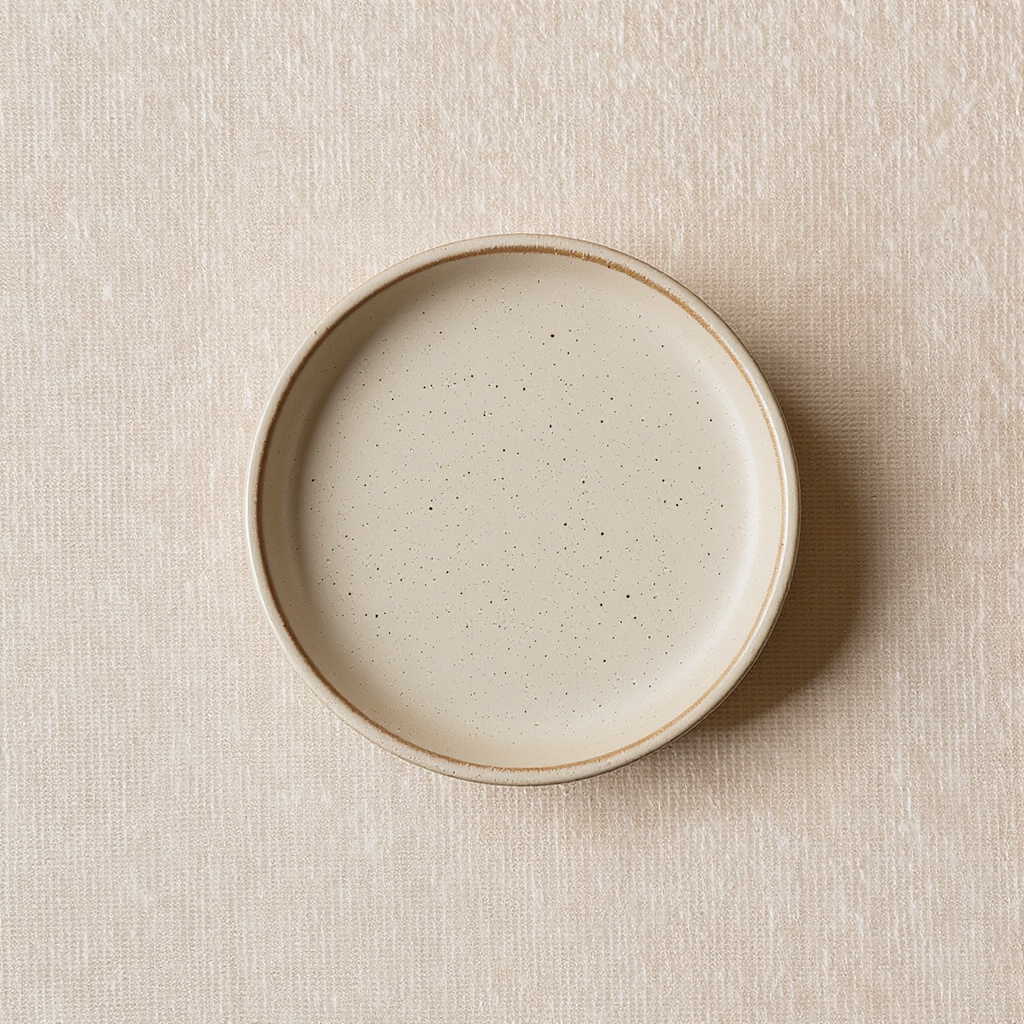
Prototype 006
Interval Dish
The pause between courses deserves its own object.
The Interval Dish holds the sorbet, the palate cleanser, the small thing that signals a transition. It is not an appetizer plate and not a dessert plate — it exists at a specific moment in the sequence, and its form reflects that specificity. 100 mm. Not a shared surface. Not a decorative object. A single-serving pause.
The meal rests. The table waits. The Interval Dish earns its place.
| Diameter | 100 mm | Single serving. The dish does not share. One person, one pause, one small object on the table. |
| Well depth | 8 mm | Near-flat. The dish is a surface, not a container. It holds a small amount of sorbet or granita — the food sits in the plane, not in a well. |
| Rim height | 4 mm | Barely perceptible. The rim barely exists — it is the edge of the dish, not a wall. A trace of containment, not a boundary. |
| Rim angle | 15° from horizontal | Shallow. The rim is a gentle rise — enough to give the dish a defined edge, not enough to contain volume. |
| Base | Flat base, no distinct foot | The dish sits flat on the table. No foot ring — at 100 mm, the base is the foot. Ground smooth on the base surface. |
| Thickness | ~4 mm at centre, ~5 mm at rim | Thin. The dish reads as a disc of ceramic — present but not heavy. The thin profile is part of the experience: the dish is almost too small to be real. |
| Weight | ~80 g | Extremely light. The Interval Dish weighs almost nothing — it feels like it might disappear. That is intentional. |
| Surface finish | Matte, fully vitrified | Interior iron oxide wash. Unglazed outer rim and base. Same material language as the Anchor Plate. |
100 mm is smaller than it seems. It is not a useful diameter for anything except the specific thing this dish does: hold a single portion of something that needs to be eaten between courses. The smallness is the point — the Interval Dish is almost too small to be a plate, and that almost-quality is what makes it right for the pause. It signals: this is not the meal. This is the space between.
Sorbet and granita are eaten from a flat surface — they melt and flow. A deep well would collect liquid at the edges, where it chills and separates. The near-flat surface keeps the palate cleanser in the centre, where temperature is most consistent. The 8 mm depth is a functional decision, not a decorative one: it is exactly enough to keep the sorbet from sliding off the edge.
At 80 g, the Interval Dish weighs almost nothing. When a server places it on the table, it barely registers. When the guest picks it up, the thin profile and light weight communicate something specific: this is a brief object. It does not demand attention. It does not invite lingering. It is there, it is used, it is cleared. The weight is the form's argument about the pause itself.
The Interval Dish belongs to a sequence. It sits between the first course and the main, or between the main and dessert. Its placement in that sequence — as the smallest, lightest, most temporary object on the table — communicates what the pause means: this is not a course. This is a breath. The dish looks like a breath.
Fine stoneware. Iron-rich Belgian clay body, 3–5% iron oxide content. The thin profile (4–5 mm) demands a clay body with excellent drying and firing behavior — the flat disc form is susceptible to warping in the kiln, particularly at the rim. The clay body must maintain flatness through the cone 10 firing with minimal deformation.
1260°C — 1280°C. High-fired stoneware. The flat, thin profile makes the Interval Dish sensitive to differential shrinkage — the workshop should fire on a flat kiln shelf with minimal setter interference. The small diameter means warp risk is lower than a larger flat form, but the thin cross-section requires even heat distribution. Bisque at 900°C, glaze firing at cone 10.
Interior: iron oxide wash, consistent with the rest of the Meld collection. The thin wall means glaze application must be controlled — the iron oxide wash is applied in a single thin coat to avoid adding visible thickness to the already minimal form. Exterior: unglazed — the rim and base are exposed fired stoneware. The base is ground smooth for flat table contact.
Lead-free, cadmium-free. FDA food-safe compliant. Fully vitrified, zero porosity. Dishwasher safe — the small size is practical for washing. Hand-washing preserves the raw exterior surface. Microwave safe. Freezer safe.
Stoneware production sourced from Belgian workshops with small-form plate and disc production experience within 150 km of Antwerp.
Ignace and Charlotte built ARTISANN from a restaurant background — Ignace as chef, Charlotte as ceramicist. Their experience with small-form tableware, including amuse-bouche and tasting portion plates, makes them the natural first contact for the Interval Dish. The small diameter and thin profile are technically demanding but well within their production range — Charlotte's jiggering precision is suited to the flat disc form.
Why this workshop: Restaurant familiarity with small-form serving pieces. They understand the hospitality sequence — the sorbet course, the palate cleanser — and can design the Interval Dish with that context in mind. Contact: artisann.be
Twenty years of sculptural and architectural ceramic work. Mie's sculptural practice — her work with thin, flat, disc-like forms — is directly applicable to the Interval Dish. She has produced comparable small-scale architectural objects with precise flatness and minimal material presence. Her process knowledge of drying and firing thin flat forms is an asset here.
Why this workshop: Sculptural thin-form experience and architectural precision. Strong candidate for a production run where the disc flatness must be held to tight tolerances. Contact via VAWAA or direct inquiry.
Bucky (Peggy Geens). Stoneware sculpture and vessels in small numbered series. Bel-Art's production infrastructure for small-scale flat forms and their experience with thin ceramic objects makes them a viable production partner for the Interval Dish. Their firing protocols match the cone 10 spec and their finishing standards are gallery-quality.
Why this workshop: Trade-ready production with small-scale flat-form capability. Best for larger production volumes if the Interval Dish moves to a full run beyond the prototype. Contact: bel-art.be
Recommended workshop: Contact ARTISANN first. The Interval Dish's thin, flat form requires specific attention to warp control during firing. Request a prototype with focus on: rim flatness (the edge must be even, not warped), base groundness (flat table contact), and overall weight consistency across the production run (80 g ± 5 g).
Prototype 006 — awaiting first production run
The smallest object. The most specific purpose.
← Collection